


 Deutsch
 English
 Español
 Français
 Nederlands
 Português


 Share
Share




The Semiconductor Standoff: How US-China Tech Decoupling is Reshaping Global Supply Chains
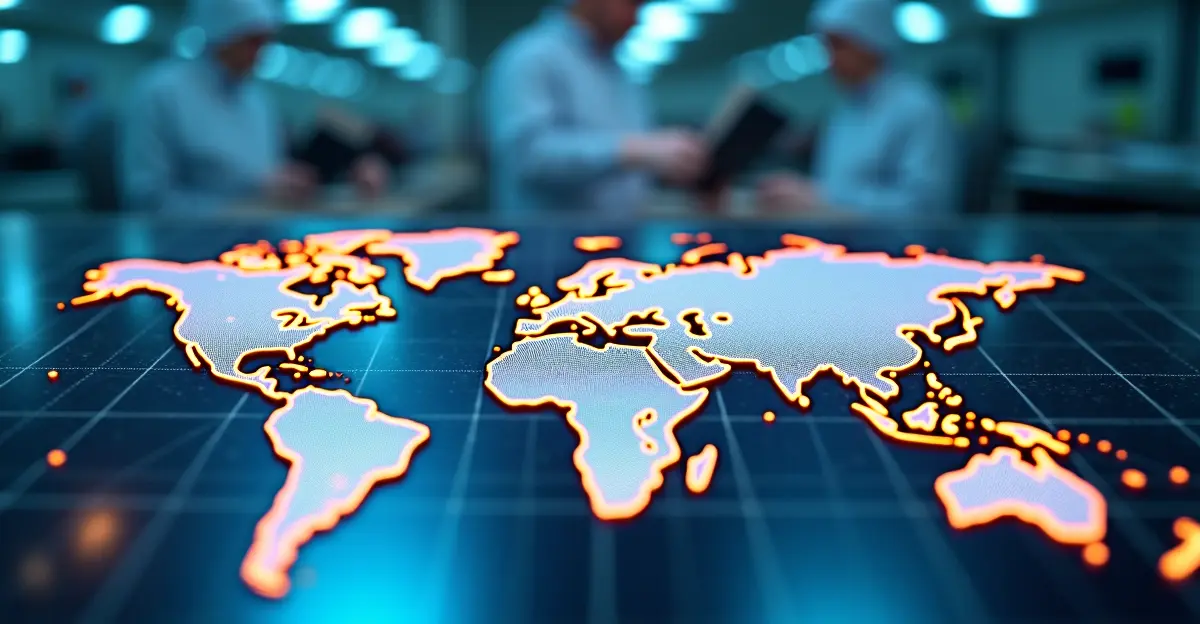
The escalating US-China semiconductor standoff has triggered a fundamental restructuring of global technology supply chains, creating distinct 'chip blocs' and forcing nations to choose between competing technological ecosystems. Recent analyses from CSIS and the Atlantic Council reveal that while US export controls have disrupted China's access to advanced chips, they have simultaneously accelerated Beijing's unprecedented push for technological self-sufficiency, fundamentally altering the dynamics of global technological competition.
What is the Semiconductor Standoff?
The semiconductor standoff refers to the strategic competition between the United States and China over control of advanced chip technology, which has become the central battleground in broader technological and geopolitical rivalry. Beginning with the October 2022 export controls that restricted sales of advanced chips and semiconductor manufacturing equipment to China, the conflict has escalated into a comprehensive decoupling effort. Semiconductors, often called the 'brains' of modern electronics, power everything from smartphones to military systems, making control over their production a matter of national security and economic dominance. The global semiconductor industry has become the primary arena where US-China tensions manifest, with both nations investing unprecedented resources to secure technological leadership.
The Effectiveness of Export Controls vs. China's Resilience
US semiconductor export controls, while initially disruptive, have produced mixed results according to recent analyses. The Congressional Research Service report R48642 details how the October 2022 measures specifically targeted AI chips and chip-making equipment, representing a significant escalation in efforts to control technology transfers. However, China's response has been equally dramatic: the country achieved 28% semiconductor self-sufficiency in Q4 2025, up from just 16% in 2024, driven by $150 billion in state subsidies and SMIC's breakthrough 7nm chip production without EUV lithography.
China's Asymmetric Strategy
Rather than pursuing symmetric competition across all fronts, China has adopted an asymmetric approach focusing on targeted breakthroughs in key areas while leveraging its vast domestic market. According to ChinaBizInsider analysis, the strategy concentrates on upstream weaknesses: EDA software (dominated by US/German firms), semiconductor materials like photoresists and silicon wafers (controlled by Japanese companies), and critical equipment like lithography machines (monopolized by ASML). This approach has yielded surprising results, with Huawei achieving 100% domestic sourcing for its Kirin 9100 processor and massive talent repatriation bringing 3,000 engineers back with 5x salary packages.
Emerging 'Chip Blocs' and Global Realignment
The semiconductor market is bifurcating into two incompatible ecosystems, forcing companies worldwide to choose between serving China or the West. The US-led bloc includes the expanded Chip 4 Alliance (US, Japan, South Korea, and Taiwan) with strengthened incentives under the CHIPS Act. Meanwhile, China is building its own technological ecosystem through initiatives like the National Integrated Circuit Industry Investment Fund, which has invested over $49 billion across two phases to develop domestic semiconductor capabilities.
Impact on Allied Nations
The standoff places allied nations in precarious positions. Taiwan, which produces over 90% of the world's most advanced chips through TSMC, faces particular vulnerability despite its critical role. According to a ScienceDirect analysis, Taiwan's semiconductor industry must navigate complex geopolitical risks while maintaining its dominant position. South Korea's Samsung leverages Korean neutrality, while SK Hynix maintains ambiguous Chinese operations. Japan, with its control over critical semiconductor materials, plays a pivotal role in both ecosystems. The global trade restructuring documented by McKinsey shows US-China trade fell by 30% due to tariffs, with the US replacing two-thirds of this gap with imports from other partners.
Economic and Innovation Implications
The economic consequences of decoupling are substantial. A November 2025 ITIF report warns that in a full decoupling scenario, US firms could lose approximately $77 billion in semiconductor sales in the first year, with South Korean, EU, Taiwanese, Japanese, and Chinese firms gaining market share from these losses. This revenue decline would reduce US semiconductor R&D investments by about 24% ($14 billion), threatening long-term competitiveness. The report projects over 80,000 fewer US semiconductor industry jobs and nearly 500,000 fewer downstream jobs.
Innovation at Risk
The bifurcation of semiconductor ecosystems threatens to slow global innovation by duplicating research efforts and creating incompatible standards. As noted in the Atlantic Council report, China's substantial investments in FPGA manufacturing and design capabilities, expected to come online within 1-3 years, could price US firms out of critical market segments. This creates both availability and security risks for the US supply chain while potentially isolating Chinese innovation from global collaboration.
Military and Security Dimensions
Semiconductors have become central to military modernization, with advanced chips powering everything from hypersonic missiles to AI-enabled surveillance systems. The US export controls specifically target technologies with potential military applications, but China's progress in developing domestic alternatives threatens to undermine these security objectives. The technological sovereignty debate extends beyond economics to fundamental questions of national security, with both nations viewing semiconductor independence as essential for military superiority.
Expert Perspectives and Policy Recommendations
CSIS experts warn that export controls alone are insufficient and recommend comprehensive industrial policies to maintain US leadership. The Atlantic Council emphasizes the need for strategic investments in specialized semiconductors like FPGAs, which are critical components in military systems, electric vehicles, telecommunications, and data centers. Both organizations highlight the importance of international cooperation with allies while developing domestic capabilities.
Future Outlook: Accelerated Decoupling or Managed Competition?
The trajectory suggests accelerated decoupling, with China targeting $29 billion investment in 2026 and $50 billion by 2030 for semiconductor self-sufficiency. According to WorldUnderstood analysis, this shift threatens to reshape global tech supply chains within 18 months. However, some experts advocate for managed competition that preserves certain areas of collaboration while protecting critical technologies. The geopolitical technology landscape will likely see continued fragmentation, with emerging economies forced to navigate between competing technological blocs.
Frequently Asked Questions
What are US semiconductor export controls?
US semiconductor export controls are regulations restricting sales of advanced chips and semiconductor manufacturing equipment to China, implemented in October 2022 to limit China's access to cutting-edge technology for military modernization and maintain US technological leadership.
How successful has China been in achieving semiconductor self-sufficiency?
China has made significant progress, achieving 28% semiconductor self-sufficiency in Q4 2025 (up from 16% in 2024) through $150 billion in state subsidies, SMIC's 7nm chip production breakthrough, and massive talent repatriation programs.
What are the economic impacts of semiconductor decoupling?
Full decoupling could cost US firms $77 billion in semiconductor sales in the first year, reduce R&D investments by 24% ($14 billion), and eliminate over 80,000 semiconductor industry jobs plus nearly 500,000 downstream jobs according to ITIF estimates.
How are allied nations like Taiwan and South Korea affected?
Allied nations face difficult balancing acts: Taiwan must protect its critical semiconductor industry amid geopolitical tensions, South Korea leverages neutrality, and Japan controls essential materials while navigating between competing blocs.
What is the long-term outlook for global semiconductor innovation?
The bifurcation of semiconductor ecosystems threatens to slow global innovation by duplicating research efforts and creating incompatible standards, potentially isolating technological advancements within competing blocs.


Follow Discussion